
By Jackie Kraemer
A robot that helps students find library books of interest
Middle school math teachers who analyze whether and how AI apps deepen students’ conceptual understanding of the Pythagorean theorem
A tech-enabled kitchen that allows elementary students to plan, prepare, and serve a full meal—including a fancy dessert—to younger students (and themselves!) on their own
On a visit to Shanghai schools with my NCEE colleague Larry Molinaro, we participated in the UNESCO Teacher Center seminar for Shanghai school leaders, an annual meeting that brings school leaders and policy experts from across the globe to Shanghai to share experience and best practices and engage in dialogues with leaders from across the city’s schools. The meeting itself reflects some of what makes Shanghai schools some of the highest-performing in the world: a relentless and intentional effort to continuously improve teaching and learning across the system.
There were many fascinating things I learned in those dialogues, but the highlight of the week for me was the time I spent in schools across the city. A few things jumped out at me about them:
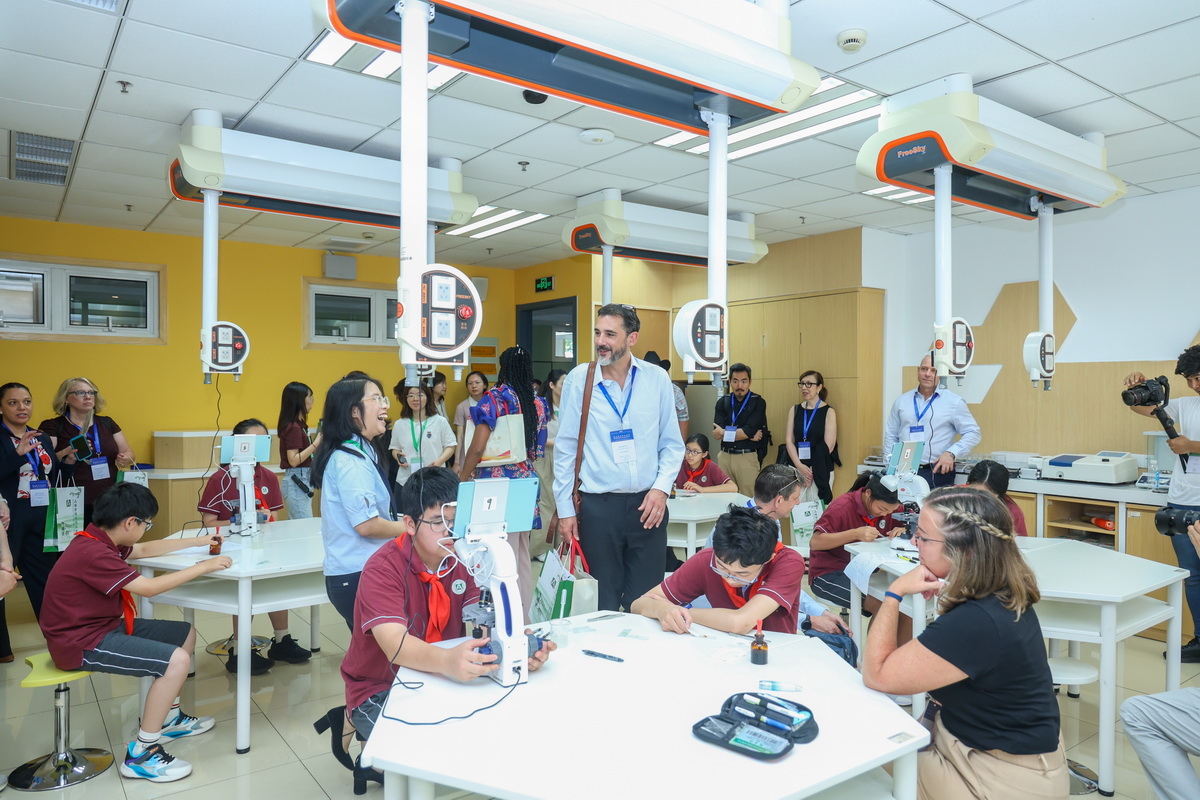
- Schools are places where teachers want to work and students want to be. The schools are not only beautiful facilities with large windows, inviting common spaces to gather, and impressive educational technology—they are filled with resources that engage students and foster the kind of skills we know young people need for a very different world. They have gymnasium-sized STEM labs with floors and bicycles that convert footsteps and cycling to energy that powers the school; TV broadcast centers where students film news and productions for their peers; music halls filled with traditional Chinese instruments as well as all the ones that would make up a band; science labs with state-of-the-art microscopes and other equipment where students conduct experiments; an interactive AI character called Alex that helps students learn English; studios for painting and art and calligraphy; and libraries filled with technology that can give students feedback on work and generate personalized discussion questions about books in the library.
- Schools are highly valued by society. The resources invested in schools reflect the high value placed on them not only by the government but also by other institutions. Almost every school we visited has a higher education and/or private company partner that works with them to design learning resources; one school partnered with a university of Chinese medicine to create a medical herb garden in its courtyard and a “teaching lab” for the “young doctors and young farmers” program it co-designed with school faculty for the elementary-aged students at the school.
- Schools are designed to be learning environments. It is not only the availability of resources—the schools seem carefully designed for learning. One teacher told us that they consider hallways as learning spaces; one hallway simulated a city street with a small bus, a taxi, yellow traffic lines, and pedestrian walk signs. Young children are taught to safely navigate their city; older children learn about traffic patterns and what it takes to maintain safe walkways and streets. Another hallway functioned as an ever-changing “museum” of the school that traced its history and added new exhibits as the students and the school reached new milestones.
- Attention is paid to the whole child. Despite China’s reputation for rigid learning, the schools we saw placed a high priority on student wellbeing. Students have breaks between periods throughout the day to move around and clear their minds. Play and exercise equipment lines the hallways and outdoor spaces; a huge crowd gathered around an interactive climbing wall at one school. Students are also taught nutrition and how to care for themselves. And the focus is not only physical health; teachers reach out to families regularly—including over the summer—to check in how they are doing. At one school, rather than assign homework over the summer they now ask students to visit a museum or other community institution. Their goal is to encourage students to explore their communities and pursue passions independently. Graduating students from one middle school showed us paintings they had made about their favorite memories from school.
- Teachers lead the system. In Shanghai, teachers do not just convey the curriculum to students; they are experts who organize and run the schools. Teachers spend the majority of their day engaged in research and planning and learning. These are all seen as activities that make teaching better, and that mission permeates the schools. One tour guide pointed to a room where students volunteer to provide feedback on new lessons teachers want to “try out.” We sat in on a teacher meeting where teachers presented different ways of organizing the same core content and discussed ways to optimize lesson time. Teachers are the frontline researchers in figuring out how to use AI to transform learning. The month prior to our visit was “use an AI app in a lesson” month in Shanghai; across the city teachers posted what they did, and their experiences were the focus of the teacher meetings. The job of teachers is not only to teach but also to innovate and continuously improve their schools.
It struck us that we were not just seeing some notable and interesting examples—we were seeing the future of schools as they could be.