Global Dispatch is a monthly examination of the research, developments, and questions shaping education and economies around the world. Each issue draws on evidence and experiences from across education systems, offering a global perspective for those studying, leading, and influencing the future of education.
In this inaugural issue, we explore the results of the 2025 Programme for International Student Assessment (PISA),the largest comparative assessment of student learning in science, reading, and mathematics. We analyze the findings, feature reflections from the OECD’s Andreas Schleicher, and chart the United States’ science performance alongside the world’s highest-performing education systems.
We also share a snapshot of the conversations NCEE leaders are taking part in alongside the 81st session of the United Nations General Assembly in New York City.
Want to get the Global Dispatch straight to your inbox each month? Sign up now
Q&A with Andreas Schleicher, OECD
Andreas Schleicher is Director for Education and Skills. Ninety-one countries and economies participated in PISA 2025. You can watch the full conversation here.
There’s been so much talk about declining scores. How do you make sense of it?
The world is changing a lot faster than our capacity to adapt to it, and nowhere is that clearer than in reading. It’s not just that overall scores are dropping. It’s the capabilities that matter most in an AI world — triangulating information, distinguishing fact from opinion, navigating uncertainty, managing complexity — that have disappeared fastest, and that’s really what we need to worry about. Those are the reading skills you need if you want to check information that comes through ChatGPT now. This decline isn’t new, either. People turn quickly to explanations like COVID, but that’s not where it started.
One finding really stuck with me. We asked who the strongest digital readers were and it wasn’t the students with the most exposure to technology. It was the students who had read books over 100 pages. If you read a complex book, you have to build a whole mental world you can’t see in front of you — track a cast of characters, their motivations, how they relate — and form your own critical view of it. Some of the skills we need for the digital world are still best built in the analog one.
What surprised you most in this round of results?
The drop in family engagement. Simply asking a child “what did you do in school today” has a bigger impact on learning outcomes than family income. Parents don’t need to know all the answers. They need to show that the questions their children work on really matter to them. But comparing 2022 to 2025, family interest declined in most countries, including the U.S., and that may be part of the explanation for why learning outcomes are falling.
What can we learn from the systems getting this right?
Real progress is possible even without large resources. Cambodia gained 35 points in science since our last assessment, which is nearly two years of schooling. Turkey gained 65 points over the last decade. Costa Rica and the UK have also moved meaningfully. Change is possible.
It’s useful to look at the countries with the magic combination of equity and excellence. That’s really the challenge. In many ways, the U.S. combines excellence with inequality: in science, for example, you have a large pool of great students but 22% of your 15-year-olds struggle with the most basic foundations in the subject.
Where are the bright spots?
A few stand out. The U.S. produces a remarkably large share of the world’s top science performers, even though it isn’t a top-performing system overall. And American students are more likely than students in many high-performing Asian systems to see science and technology as part of their future — when students enjoy science, strong performance actually translates into career aspirations, and that’s clearly a strength here.
Relationships are another. Even as family engagement has slipped, the quality of student-teacher relationships is a quite robust predictor of student learning outcomes and in many countries, that support has actually improved.
Chart of the month: How Far Ahead are the Top Performers in Science?
While the US performs above the OECD average in science on average, it still trails the highest performing systems by a significant margin.
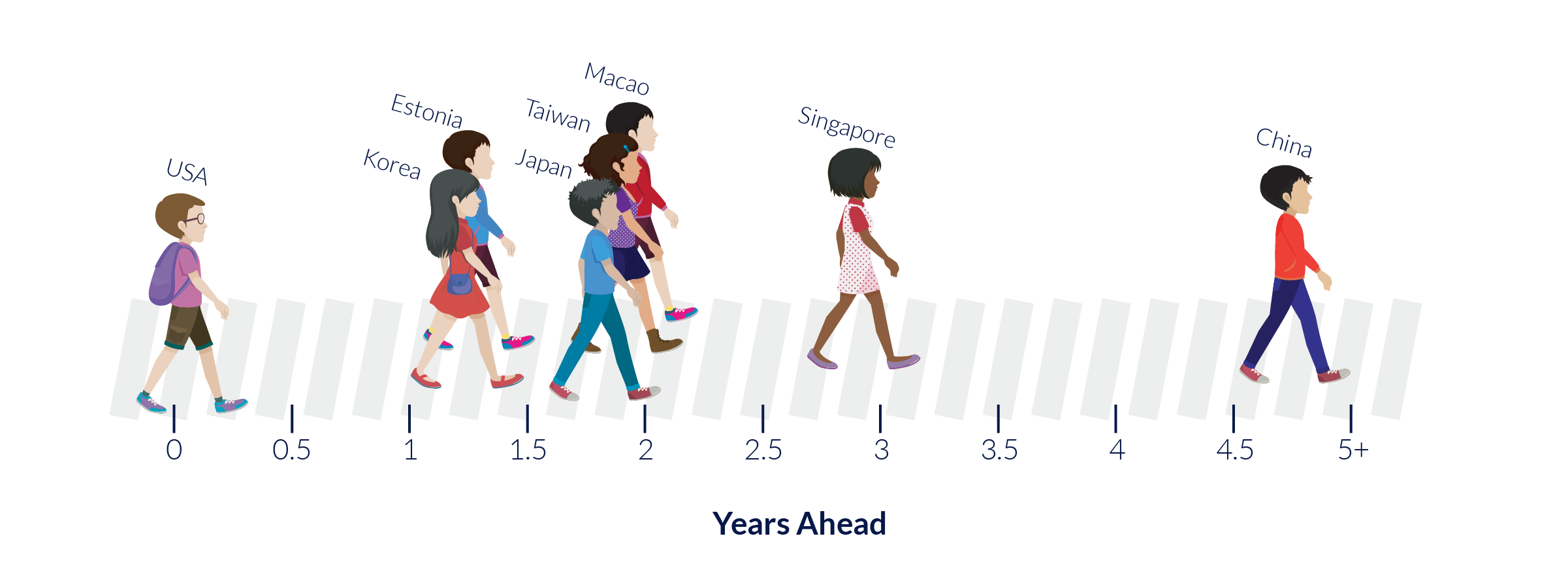
For PISA 2025, a score difference of 20 points is equivalent to a year of formal schooling. This graphic shows top-performers in science on PISA 2025 compared to the US based on the difference in mean scores.
Systems Snapshot: What Did PISA 2025 Tell Us?
The 2025 PISA results are sobering. Average scores across the OECD are now the lowest ever recorded, with reading posting the steepest decline of this cycle — down 14 points on average worldwide.
Some of this reflects the long tail of the pandemic: the 15-year-olds tested in 2025 were just 9 or 10 years old when schools shut down in 2020. It won’t be until 2033 that PISA measures a cohort untouched by that disruption. But that’s not the whole story — scores were already declining well before. Reading has declined since 2012, science since 2015, and mathematics has fallen especially sharply after 2018.
Where the U.S. stands
The U.S. mirrored the global reading decline. Math and science scores have held steady since 2022. Notably, the U.S.’s relative standing actually improved, even though its scores didn’t: other countries fell further and faster. In 2022, 25 systems statistically outperformed the U.S. in math; in 2025, that number dropped to 19. In reading, the gap narrowed from 5 systems to 3. In science, it fell from 11 to 7.
Achievement gaps between the highest- and lowest-performing U.S. students have held steady since 2022 — but they remain wider than a decade ago. Seventeen percent of US students score below baseline proficiency across all subject areas, up from 14 percent in 2022 but still below the OECD average of one in five.
Who’s leading and by how much?
Chinese provinces and Singapore were the top performers across all three subjects, with their advantage over the U.S. equivalent to years of additional schooling. They are up to:
- 5 years ahead in science.
- 2.5 years ahead in reading.
- more than 5 years ahead in math.
Japan, Korea, Macao, Taiwan, Estonia, and the UK also placed among the top performers across subjects.
China, Canada, Estonia, Ireland, Japan, Korea, and Macao managed to combine high performance with equity, a pairing that remains rare across the OECD.
Still, even those who ranked among the highest saw scores stall or even decline over the last few years.
A caution on the data: The U.S. results come with an asterisk: the country didn’t meet PISA’s minimum participation requirements and should be interpreted with that caveat.
NCEE in the World: UN General Assembly
NCEE CEO Vicki Phillips and Chief of Global Strategy and Research Tracey Burns were on the ground for the United Nations General Assembly (UNGA) gatherings in New York this month.
From a keynote at the Education Futures Forum; a Diplomatic Courier salon on future signals; a Knowledge Exchange Breakfast with NCEE, Brookings Institute, HundrED, among many other partners; and a workshop on navigating disruption at Education House, the team was engaged in global dialogues about where education systems are heading.

Vicki Phillips delivers the keynote at the Education Futures Forum hosted by Diplomatic Courier for UNGA81 Dialogues | Sept 2026
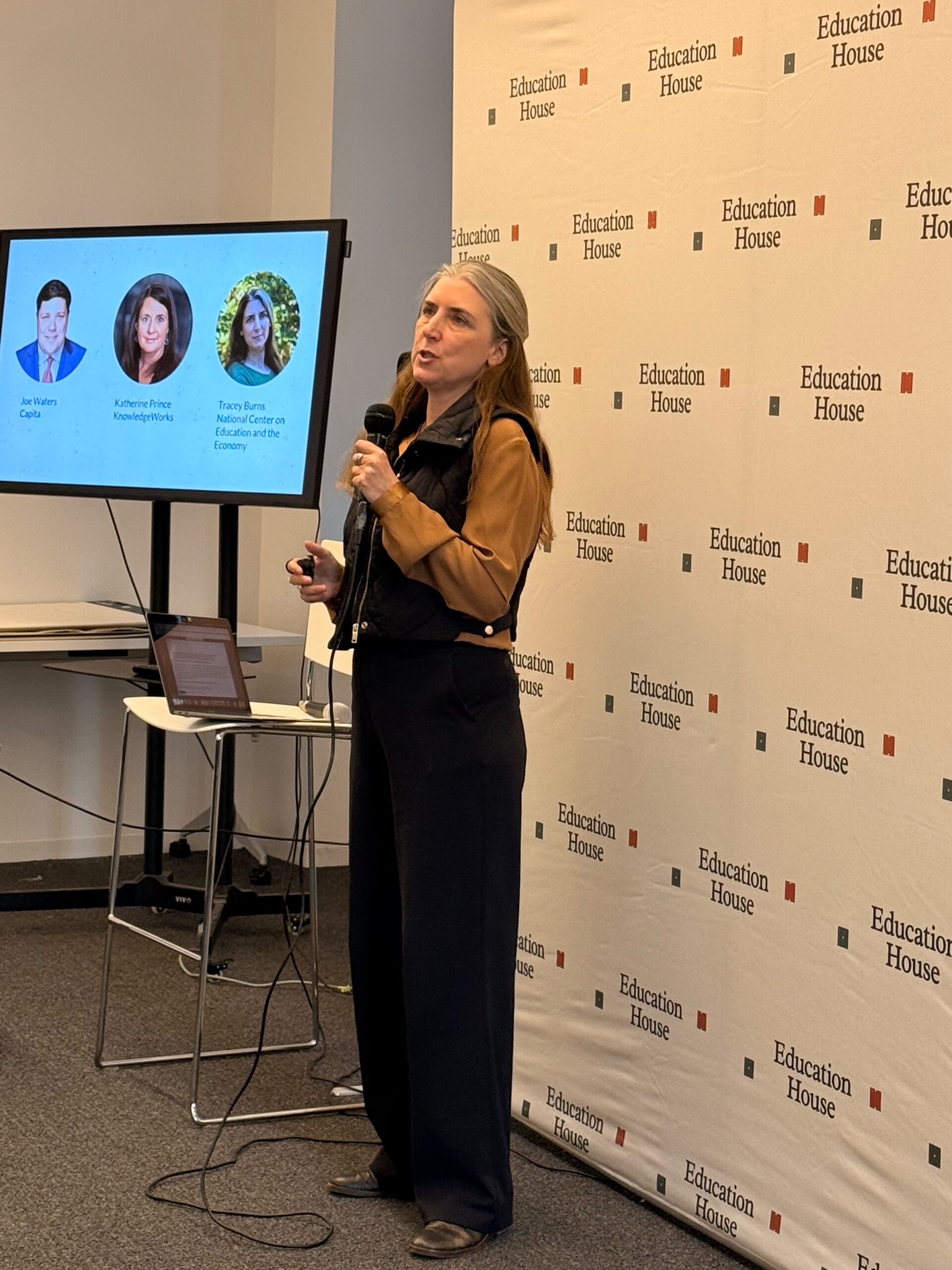
Tracey Burns speaks during the Navigating Disruption workshop at Education House for UNGA81 | Sept 2026
Get The Global Dispatch straight to your inbox each month
Each issue draws on evidence and experiences from across education systems, offering a global perspective for those studying, leading, and influencing the future of education.
"*" indicates required fields